
The UK has made a significant step in creating a world-class nuclear medicine center.
The Nuclear Medicine Supercluster (known as Nm-90) is an innovation and manufacturing hub, strategically located next to Manchester airport. When completed, it will facilitate unrivalled connectivity to the rest of the UK and the world.
Life Couriers were in attendance at the launch of this milestone for nuclear medicine, offering our expertise as the global leaders in radiopharmaceutical transport.
Rebuilding the UK’s nuclear medicine infrastructure
Spearheaded by Andrea Winders, CEO of Nm-90, the project will create the UK’s first centre for excellence in nuclear medicine, comprising cyclotrons creating life-saving radioisotopes, and a research and treatment centre for developing world-leading cancer care.
In her welcoming address, Winders made clear the increasingly pressing need to establish a strong supply chain in the UK for ‘home-grown’ radioisotopes, and change course on the current reliance on imported Radiopharma. At present, the UK sources around 90% of its radioisotopes overseas, the majority of which originates in continental Europe, with some from the USA and Russia.
A wake up call for the nuclear medicine community occurred in 2024, when several key reactors in Europe were temporarily shut down, resulting in a global shortage in a variety of radionuclides essential for the treatment of cancer.
Speaking to the UK’s own Radiopharma infrastructure, Winder’s stated: “at best the infrastructure is fairly weak, at worst, virtually non-existent, particularly for patients in certain areas of the country.” The ambitious goal of the Nm-90 group then, is to rebuild the UK’s nuclear medicine infrastructure to provide better care for cancer patients in the UK, while also inviting international collaboration for improved global health outcomes.
The Supercluster roadmap
Among the issues requiring immediate attention to upgrade the UK’s outdated infrastructure are a lack of sovereign isotope production, combined with a shortage of clinicians, consultants and other health experts to administer tailored care for cancer patients.
At present, the UK has only one high-energy cyclotron, which is around 50 years old, with an additional 20+ more smaller cyclotrons (with an average age of 12-15 years). This is not enough to meet the needs of patients and the growing NHS demand.
Yet this need is being addressed. Alongside the Nm-90 proposal, Siemens Healthineers recently announced a £26m investment to create a new radiopharmacy that promises to deliver up to 8 times the production capacity of conventional cyclotrons.
Such significant developments in the UK pave the way for greater collaboration between regions, which plays a key role in creating what Winders describes as a “hub-and-spoke network”. By creating hubs (like the supercluster in Manchester) that connect to smaller ‘spokes’, such as a diagnostic and treatment centre in Liverpool or Scotland, this builds towards a future where every part of the UK has access to life-saving radioisotopes.
A call to arms from Winders aptly summarised both her team’s ambition as well as the cooperation required: “This is going to take more than just a village – this is going to take a whole nation.”
Juggling ice cubes: the unique challenges of Radiopharma logistics
Many conversations revolved around logistics and the importance of transporting these life-saving products safely, securely, and efficiently.
One particularly pertinent metaphor for the transportation of radiopharmaceuticals came from Mike Hannay, Chief Product and Supply Chain Officer at Bicycle Theranostics. Speaking to the difficulties related to transporting isotopes (which may have half-lives of as little as 8 hours or less), Hannay described the task as being like “juggling ice cubes”, and for many other speakers on the day, logistics was discussed as a vital pillar of the success of the nuclear medicine supercluster.
As the global leaders in transporting radiopharmaceuticals, Life Couriers were able to offer unique expertise at the event, drawing from nearly 50 years in Radiopharma Logistics. Our UK-wide driver and warehouse network has been created to serve the stringent demands of the radiopharma industry, with reliable and secure transport for every stage of the radiopharma supply chain.
Representing Life Couriers on the launch day were Claude Poliart (Global Head of Radiopharma), Martin Lacy (Business Development Manager), and James Tattington (Marketing Executive).
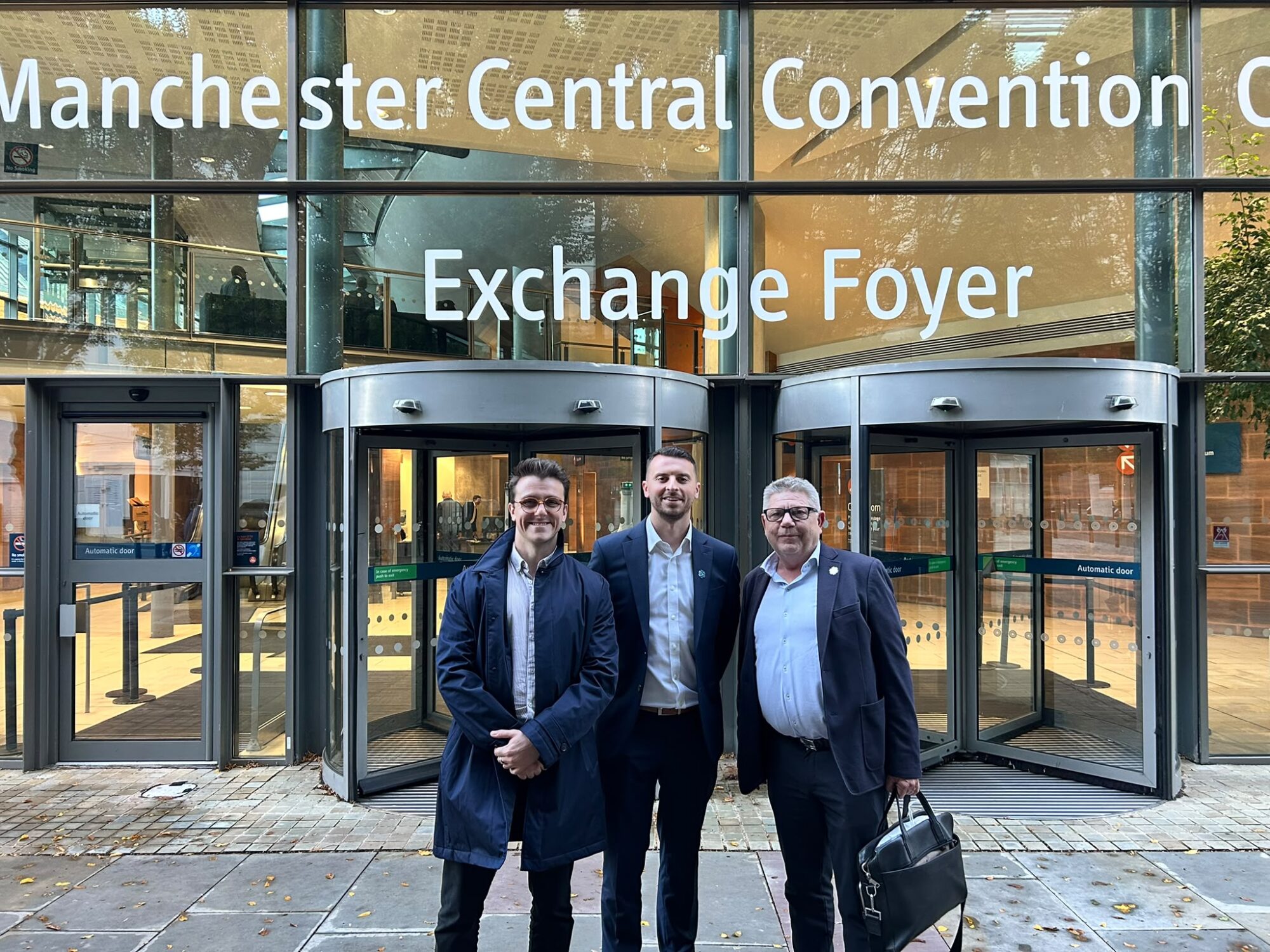
The Life Couriers team in attendance at the Nm-90 launch event. (L-R) James Tattington, Martin Lacy and Claude Poliart.
The power of nuclear medicine to save lives
The majority of the speakers at the Nm-90 launch event came from the world of nuclear medicine, whether showcasing their extensive clinical expertise, experience as an educator, or knowledge from within the radiopharma industry.
However, one speaker stood out by providing a moving personal account of their experience as a cancer patient. Andrea Winders sat down with Brian Sugden CBE to gain a better understanding of his experience, where radiopharma diagnosis and treatment helped him to a “miraculous” recovery.
After an accident at home led to a brief stay in hospital, Brian underwent a panel of tests and screenings, resulting in the discovery of an aggressive cancer in the prostate. After initially responding well to chemotherapy, Brian was advised by his oncologist to consider a targeted treatment in the form of an FDA-approved radioisotope, which has shown to be particularly effective in the treatment of prostate cancer.
This proved to be a remarkable success and many in the audience were stunned by Brian’s story of recovery, especially given his revelation that barely a year earlier he would have been unable to walk without assistance, and yet confidently walked across the stage unaided to speak to the audience.
What was clear from every speaker, whether they represented the pharmaceutical industry, or had a clinical or research background, was a deeply held belief in the power of nuclear medicine to save lives. Many more touching stories were shared but the motivation behind them all was clear: the development of a centre for excellence in nuclear medicine will benefit cancer patients all over the UK, and the enhanced collaboration between neighbouring countries will lead to better patient outcomes around the world.
“Innovation will only see its full value when we see the benefit to the patient”, so said Dr Sobhan Vinjamuri, Lead Consultant in Nuclear Medicine at University Hospitals of Liverpool Group. This sentiment perfectly captures the ambitions and goals of the Nm-90 Supercluster, and for Andrea Winders and her team, they’re only just getting started.
Further reading
See how we’re saving lives through our Radiopharma Logistics service.
Or speak to our experts to see how we can support your Radiopharma supply chain.